Categories
COVID-19

Thoughts on COVID-19 May 26, 2020

Mother and child during COVID-19 crisis/https://www.vperemen.com/Wikimedia Commons

Last week I was on call for public health and wasn’t able to post much. This long weekend was about recovering from call. Hopefully I’ll get back into a more regular schedule this week.

  • The Basic Reproduction Number (R0/R-naught) for the US looks like it has crossed back above 1 for the whole country. The R0 is important if you remember because it describes how many people on average are infected by one person. As long as that number is below 1, COVID-19 cases will drop. Once it goes above one as it has now (estimated by Youyang Gu on his site) we’ll start to see overall increases in new cases of the virus nationwide.
  • Imperial College’s new study (not yet peer reviewed) reveals that 24 states have COVID-19 reproduction numbers that are above 1 (one) and therefore have growth of the virus. Their model which incorporates changing mobility of the population further reveals that only 15.7% of US states have truly credible reproduction numbers below 1 (one).
  • An article in Pediatrics examined the role children play in spreading COVID-19. Swiss researchers looked at family clusters of infected individuals and found that child to adult spread occurred in only 8% of cases. It was far more common for adults to spread the virus to their children. If this is true and validated by other studies it could have significant implications for the reopening of schools. It’s important to remember that children may still be important vectors for the disease since they have have a higher likelihood of having few or no symptoms even if they don’t spread the virus as commonly as adults do.
  • There were 675 new cases of COVID-19 in Riverside County over the Memorial Day weekend from Friday to Tuesday. This is a significant bump with an average of 168 cases per day over the four days. A few weeks ago, the county had been averaging under 100 cases per day. This increase is worrisome and very likely due to several factors including spread during Mother’s Day gatherings 2 weeks ago. Citizens of Riverside County have been much more mobile in recent weeks and now have a failing grade with Unacast Social Distancing Scorecard. It’s also likely that social distancing is less rigorous in general as quarantine fatigue has fully set in. Additionally, face coverings are no longer mandatory in Riverside county, an order rescinded by the Board of Supervisors–this factor alone may play the largest role in increasing numbers now and in future weeks. One might suggest that increased testing is responsible for the bump but testing is actually down in Riverside County so in all likelihood, we’re seeing higher numbers because the virus is spreading more. This is what viruses do when given the chance. As the county opens up under the Governor’s new criteria and people feel more comfortable congregating in churches, at the beach, in restaurants and in stores, look for the daily new cases to climb further.
Categories
COVID-19

Routine Vaccinations Plummet in US During COVID-19 Crisis

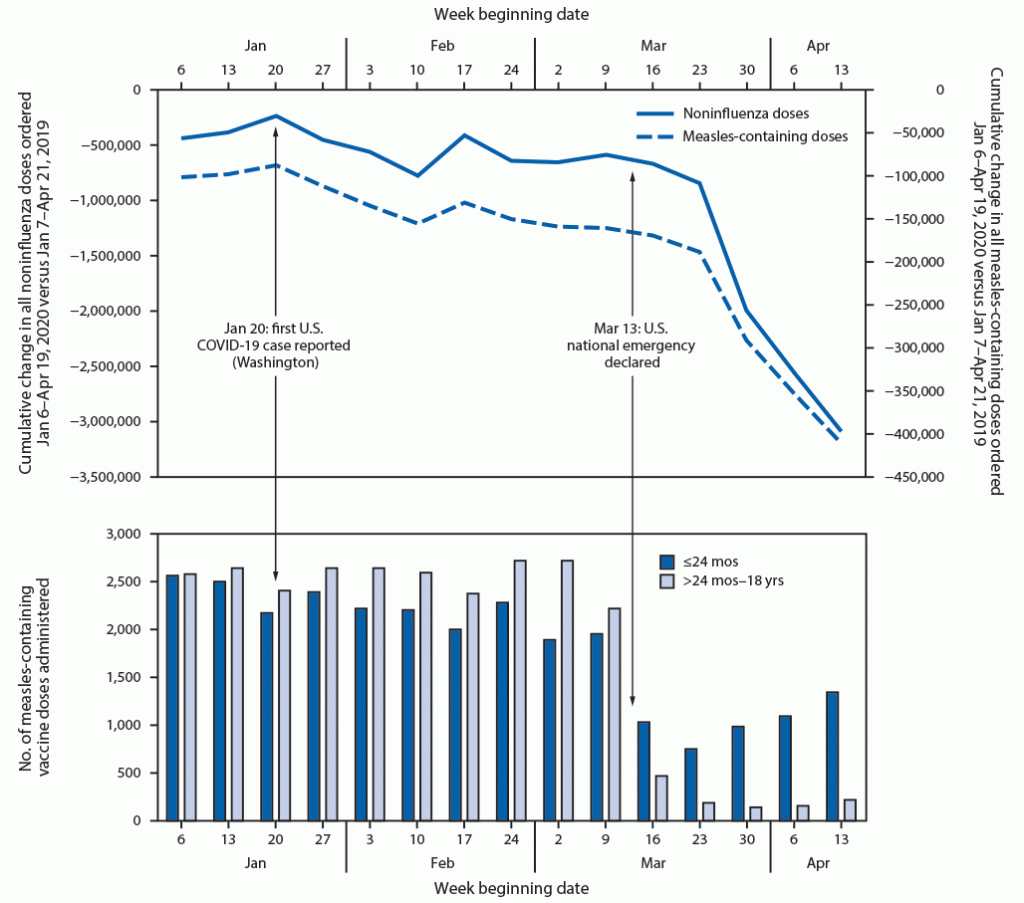
Vaccines For Children (VFC) study showing week to week differences in vaccines ordered from the VFC for non-influenza routine vaccines and measles containing vaccines and week to week comparison of administered measles-containing vaccine.

Santoli JM, Lindley MC, DeSilva MB, et al. Effects of the COVID-19 Pandemic on Routine Pediatric Vaccine Ordering and Administration — United States, 2020. MMWR Morb Mortal Wkly Rep. ePub: 8 May 2020. DOI: http://dx.doi.org/10.15585/mmwr.mm6919e2external icon

A study by Santoli et al. is showing that there has been a sharp drop in ordering of routine non-influenza and measles-containing vaccines since the national state of emergency was declared over COVID-19. There was also a very worrisome drop in the administration of measles-containing vaccine. Parental concerns about COVID-19 have produced a sharp drop-off in routine well check exams leaving many pediatric offices nearly empty. The drop-off in measles vaccination has been much greater for kids over two years of age but both age groups have been significantly impacted. The trend is slowly reversing but the risk of a pediatric disease outbreak is growing every day as vaccines become more and more delayed. Measles vaccination rates need to be maintained at around 95 percent to prevent outbreaks so whenever a significant portion of the pediatric population is delayed with their shots, measles could take hold and spread. Rates in the US are already worrisomely low coming in at 91.5% with some states below 90%. A measles outbreak on top of our current COVID-19 pandemic could be devastating to kids and cause further strain on a critically ill economy.

Measles/CDC

Pediatric offices have made major changes to assuage parental fears of contracting SARS-CoV-2. Most practices offer telehealth visits for the physician portion of the well-child visit. When in-person visits are required, many offices now have blocked-off the morning for well patients with comprehensive cleaning between visits and before the sick visits in the afternoon. Many offices have closed waiting rooms and instead call families in from their cars when it’s time for their appointment. While protecting against COVID-19 is important for families, it’s vital that we quickly bump up our vaccination rates and provide catch-up vaccination for those behind or we risk preventable outbreaks on top of a pandemic. Contact your child’s pediatrician or pediatric care provider to see how you can get your child’s well check and vaccines taken care of so that they’re fully protected.

Categories
COVID-19

Thoughts on COVID-19

  • The Washington Post is reporting that cell phone data tracked by the University of Maryland’s Transportation Institute showed that tens of thousands of people flocked to Georgia after businesses were permitted to open. Over 60,000 more trips into the state were recorded than the week before the opening on April 24. Most of these travelers came from Alabama, South Carolina, Tennessee and Florida. I’ll be keeping an eye on new case data for these five states over the next 2-4 weeks to see if numbers there start to move and will post updates.
  • This week my home province of New Brunswick, Canada had its first new cases of COVID-19 in two weeks. At least one of the cases is travel related. The positive individuals are in the Saint John and Fredericton areas and come just as the province has begun a phased reopening. By all estimation the province’s public health department has done a superb job managing the pandemic within its borders. The new cases serve as a reminder that the virus isn’t gone and that even in communities who have done almost everything right, it will invariably find its way back in via the path of least resistance.
  • Though known for a while, there are increasing reports that patients with COVID-19 are suffering from abnormal blood clotting. A study published in the Annals of Internal Medicine found that 58% of 12 post-mortem examinations found deep vein thromboses in patients with COVID-19. There is a growing use of blood thinners to treat the sickest patients in centers around the country. It’s difficult to know at this point whether these clots are part of a well known medical phenomenon related to severe inflammatory states and shock called disseminated intravascular coagulation (DIC). In DIC, extremely ill patients both bleed too much and clot too much at the same time–it’s a clotting system gone haywire and a very difficult problem to manage in critically ill patients. Some of my worst nights during training were spent at a kid’s bedside trying to get them to stop bleeding and clotting, a tragically difficult task. It could also be that there’s something about COVID-19 that specifically causes abnormal clots to develop. Large scale studies are needed to determine the cause and to sort out appropriate treatment but blood thinners seem to be working their way into current standards of care.
Coronary Artery Aneurism in Kawasaki Disease/Wikimedia

http://pediatricimaging.wikispaces.com/file/view/price_lad_angio.jpg/235212558/price_lad_angio.jpg
  • Doctors in New York have issued an advisory warning of a possible inflammatory complication of COVID-19 in children. Sixty-four kids in New York have developed a condition described as an inflammatory syndrome affecting multiple systems including the heart and blood vessels. The syndrome appears to be similar to another more well-known pediatric condition called Kawasaki Disease. Children with Kawasaki Disease have prolonged fever, rash, enlarged lymph nodes, red lips and tongue, joint pains, swollen hands and feet, and conjunctivitis without discharge or pus. Kids with Kawasaki Disease are at risk for inflammatory changes to the coronary arteries that can cause the heart vessels to develop life-threatening aneurisms. While the new COVID-19 related syndrome affects the heart it’s unclear if it causes the same aneurisms as Kawasaki Disease or instead causes general inflammation of the organ. Some children with the COVID-19 related inflammatory syndrome have develop cardiovascular collapse similar in appearance to Toxic Shock Syndrome, a finding not typically seen in Kawasaki Disease.