Categories
COVID-19

Am I at Risk for Believing Conspiracy Theories?

https://todaytesting.com/free-social-media-marketing-free-images/

One of the really cool things about staying off of Facebook is that I’m not bombarded with conspiracy theories all day. One of the bad things about leaving Facebook is that I’m not bombarded with conspiracy theories all day. I, for instance, just found out that there’s a video called Plandemic spreading around the internet like a…well…pandemic (apologies), which is so rife with conspiratorial falsehoods it’s basically the holy grail of science blogging. I’m so late to the game on this that the video isn’t even around anymore to view. I was able to dig deeper into the bowels of the internet and find it but I’m so late to the game I’m not going to tackle it. Others have done an expert job of that already. If you’ve seen the video and found some of the points made therein to be compelling, you probably owe it to yourself to read If You Found that ‘Pandemic’ Video Convincing, Read This Too, by Beth Skwarecki of LifeHacker. I don’t think anybody could do a better job of point-by-point addressing the Plandemic video, certainly not me.

Instead what I’d rather do is provide a bit of a handy guide, a questionnaire of sorts, to help you know when you are at the greatest risk of believing a conspiracy theory. Let’s all answer a few questions about ourselves.

The Questionnaire

How helpless do you feel right now?

Do you feel completely powerless as life-altering decisions are made by people in suits miles and miles away from your reality?

How vulnerable do you feel right now?

Do you feel that there are imminent threats to your health, finances or freedoms?

How confused are you right now?

Do you feel overwhelmed by conflicting information and are finding it hard to know what to believe since information yesterday is different from today and one contradicts the other?

How threatened does your way of life feel right now?

Do you feel that there are people with ideologies counter to yours who are intent on changing the status quo to make your life worse or damage America irreparably?

How involved in political wrangling are you right now?

Do you engage in frequent arguments about politics with people who simply ‘don’t get it’ or do you frequently post memes and comments that denigrate people on the opposite side of the political spectrum?

How much social media are you consuming right now?

Do you find yourself increasingly drawn to social media platforms looking for some information that makes sense or for people who are similarly confused and frustrated with how things are going?

Discussion

If you answered, ‘a lot’ to some of these questions you’re probably at risk to believe in a conspiracy theory. The thing is, because of our current health and economic crisis almost every human on earth can answer ‘a lot’ to one or more of those questions and is probably at risk of believing conspiracy theories. That, frankly, is why there are so many flooding the internet these days.

Feelings of helplessness are commonly associated with a predilection for believing conspiracy theories. During the COVID-19 crisis many Americans feel like decisions that affect lives are being made by politicians and policy-people from hundreds of miles away. Elected and public health officials call all the shots and the average Joe has no say in the matter. The more helpless and out of control people feel, the more likely they are to try to find some measure of control. Often people try to find alternate explanations than those given by the people responsible for taking away control in the first place. Conspiracy theories provide that along with a comforting feeling that the believer is part of a select few who know the real truth.

Similarly, the anxiety that comes from vulnerability drives people to believe conspiracy theories. Millions of Americans have lost their jobs and face an uncertain future. Millions of small businesses are at risk of closing permanently because of the COVID-19 stay-at-home orders. For many, the stress of COVID-19 itself can be oppressive. Conspiracy theories can provide an explanation for the seemingly inexplicable change in peoples lives; life was completely normal four months ago and now it’s completely abnormal. Somebody or something had to be responsible for this dramatic turn of events.

The breakneck speed of COVID-19 and the response has led to unavoidable conflicting information from scientists, politicians and public health experts. Part of the fundamental nature of science is that it changes and is slowly fine-tuned or honed by additional data. This can produce an uncomfortable amount of confusion in the best of times, during the COVID-19 pandemic this has been difficult to process and keep up with for even the world’s foremost experts in virology and public health. For many, this confusion reaches a tipping point that leads them to conclude that events transpiring are simply too fantastical to believe. From there they seek alternative explanations and find many, much easier to chew than the science of pandemics, in conspiracy theories.

According to recent research, people who feel that fundamental societal values are under siege or directly threatened by those who believe differently are at an increased risk for believing in conspiracy theories. These individuals are likely to believe that there is an influential group of people who do not share the same values and are intent on disrupting the status quo. For people who feel this way, there is a common thread that nothing happens by accident; there is always someone or something at play to explain current problems or crises.

Studies show, the more politically entrenched a person is or the more they feel their way of life is threatened, the more likely they are to believe in conspiracy theories regardless of which end of the political spectrum they live. Generally, the politically preoccupied believe conspiracy theories that malign the other party and the people who belong to it. To make matters worse, the more someone overestimates what they know about politics or policy, the more likely they are to believe in clandestine, powerful agents acting against the common good. Having entrenched views and overestimating personal knowledge are particularly strong risk factors for belief in conspiracy theories.

The internet, in particular social media, provide people a perfect medium to spread unfounded ideas. The relative absence of gate-keepers gives free rein to conspiracy theorists to post their claims and allows them to find thousands of like-minded believers. This can give the group in question the gratifying feeling that they alone have the truth and that they share a secret that the rest of the world is ignorant of. In general, conspiracy theorists are far more active and share far more posts on social media than the people who debunk them. In part this comes from the belief that they have a secret truth that must be shared. Social media intensifies conspiratorial thinking.

The COVID-19 pandemic has created a perfect storm of risk factors for believing conspiracy theories. We’ve reached a point where almost every American has at least several of these risk factors and we’re seeing that play out on social media with an infectious spread of machinations designed to dupe vulnerable people into believing untruths. Honestly, I think it’s understandable; we all have doubts and we all want the truth so we go looking. It’s good to have an inquisitive and questioning mind. It’s vital though, to know when the answer to our inquisitiveness is devoid of real evidence. Most of us laugh when we hear someone bloviate about the “clear evidence” of a flat Earth or the undeniable “truth” that the moon landing was faked. For many of us, these ideas are so absurd that we ignore them and refuse to engage. It’s important to remember, however, that a belief in conspiracy theories, no matter how bizarre, is underpinned by a fundamental mistrust of science and expertise and the more pervasive these ideas, the more dangerous it is for society. We see this now with the conspiracy theories surrounding COVID-19; they are a direct threat to our personal health and the health of our economy (see On Bitter Pills). When society relies on every member to step up to protect the common good, it only takes a few to endanger the lives of millions. Since we all have some risk these days, it’s vital we steel our minds and take a moment, maybe several, before we post that potentially conspiratorial or highly political meme. Better still, take a break from social media or at least let’s clean up our social media feeds to remove the incendiary pages, and for the love of all that is good and holy, don’t ever look at the comments. No good can come from that.
Categories
COVID-19

Thoughts on COVID-19

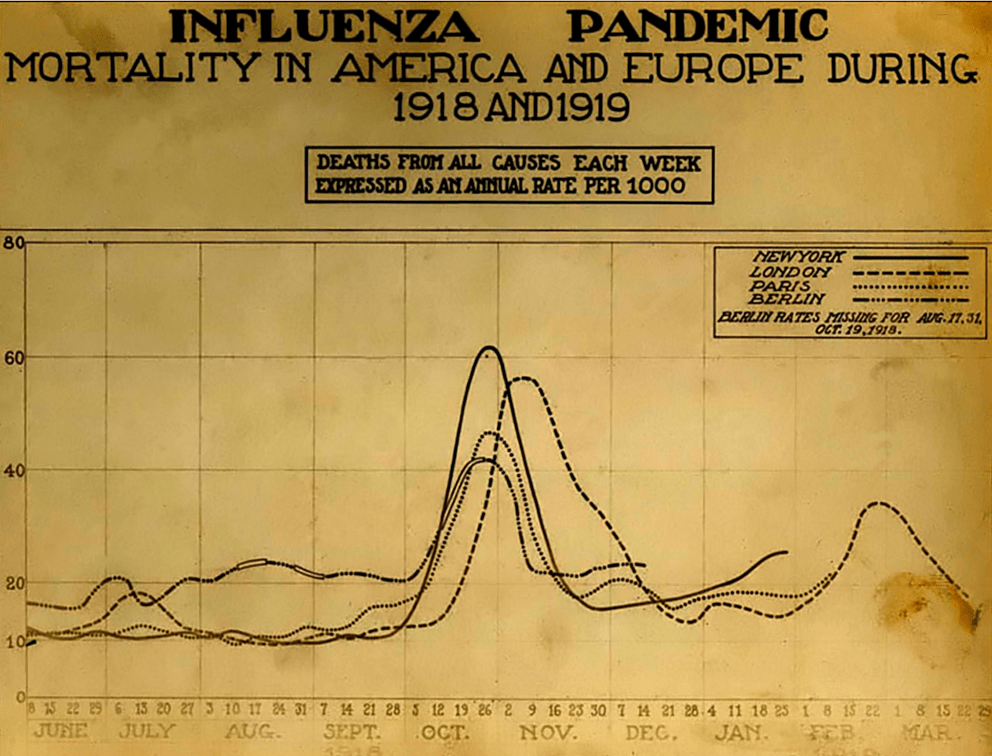
The fall Influenza peak in 1918/1919 following a smaller peak in the spring of 1918 (not shown in this graph)

By (Image: courtesy of the National Museum of Health and Medicine) – Pandemic Influenza: The Inside Story. Nicholls H, PLoS Biology Vol. 4/2/2006, e50 https://dx.doi.org/10.1371/journal.pbio.0040050, Public Domain, https://commons.wikimedia.org/w/index.php?curid=1441889
  • Governor Newsom announced the start of Phase II of California’s COVID-19 response today by allowing limited pick-up service openings for businesses like book stores, sporting goods stores, and florists as early as this coming Friday. This is a measured loosening of restrictions to be sure as there’s no real congregating allowed and this is probably the most that could safely be undertaken at this point. We have not met several of the criteria outlined by infectious disease experts for safe relaxation of stay-at-home orders. In particular, while testing is increasing, we are not at the level where comprehensive evaluation of any symptomatic person can be achieved with results on the same day or within hours. Additionally, it’s not clear that daily new cases are declining let alone for 14 days straight, another of the primary relaxation criteria. Given this, it’s a bit of a risk to begin loosening of restrictions at this point but I’m guessing he hopes allowing these relatively safe activities will help put an end to the incredibly risky behavior of protesters around the state in recent days. Some experts like Dr. Robert Kim-Farley from UCLA are predicting that Phase III which will include the opening of higher risk businesses like movie theaters and gyms might occur sometime in the late summer, possibly August or September. Timelines like this are notoriously difficult to predict however, since they sometimes depend on non-medical decision making by political leaders. I wouldn’t be shocked to see that timeline bumped up somewhat.
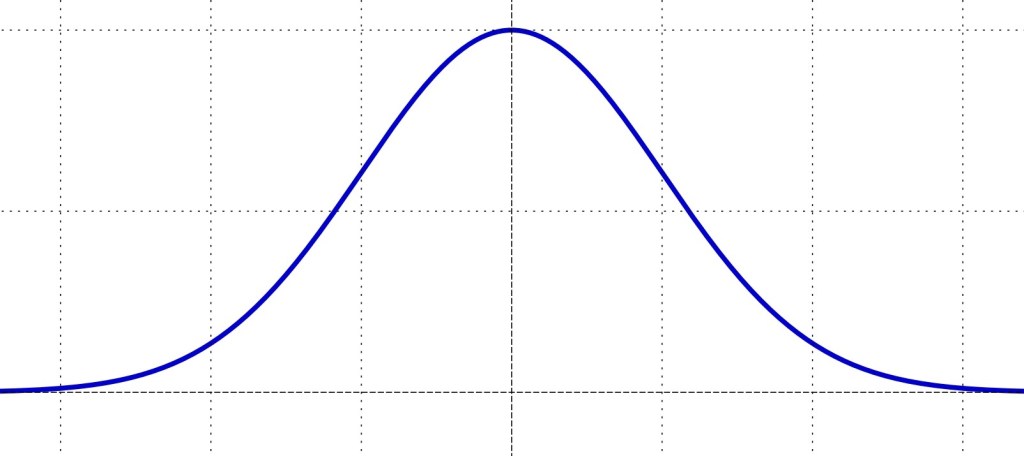
  • It seems pretty clear now that the United States’ COVID-19 disease course is not following a Gaussian curve with an equal slope on the way up to and down from the peak. Instead the disease is declining at a much slower rate than when it ramped up to the peak. This slow tapering recovery will unfortunately lead to significantly more cases and deaths from the initial disease surge than predicted by models that assume a Gaussian distribution as there will ultimately be more area under the curve.
  • Michael Osterholm, a foremost expert on viruses and pandemics who many people saw for the first time on Joe Rogan’s podcast is the Director of the Center for Infectious Disease Research and Policy (CIDRAP). Last week his group at CIDRAP released a report that describes three possible pandemic wave scenarios based on lessons learned from previous pandemics. The first scenario sees one to two years of recurring peaks and valleys similar to what we’ve just experienced requiring periodic reinstitution of mitigation measures like we’re currently living under. For obvious reasons, this scenario could have dramatic economic repercussions. The second scenario mimics the 1918 influenza pandemic which saw an initial peak in the spring and a massive, much more devastating peak in the fall after relaxation of social distancing measures during the summer. This second peak would almost certainly overwhelm our healthcare system and lead to very large numbers of deaths but would not be followed by significant peaks after the fall peak as the virus would have burned through most of the population. The third scenario describes a slow burn after the current, initial surge. In this scenario there are no peaks and valleys, just a constant relatively stable number of ongoing cases and deaths. This scenario would not require large-scale mitigation measures after the initial peak. While this pattern has not been seen with previous influenza pandemics it could occur with a novel coronavirus such as SARS-CoV-2/COVID-19. Whatever scenario plays out, the CIDRAP group advises that Americans should get used to the idea of significant COVID-19 activity for the next 18-24 months. As the pandemic starts to fade away, it’s likely that SARS-CoV-2 will continue to cause less and less severe illness over the next decade eventually settling in as a non-life threatening upper respiratory infection much like it’s other cold-causing coronavirus cousins.
Categories
COVID-19

Thoughts on COVID-19 from a New Home

For some time I’ve been considering leaving Facebook. While there are many positive aspects of the social media giant, there are some things about it that I find hard to stomach. It’s a great place to share photos of family and pets and jiu jitsu, but it’s a terrible place for conversations. The world is polarized and so is Facebook, actually, the world may be polarized because of Facebook. I love to talk science though. Writing about COVID-19, while not a cheery subject, has helped me process some of the feelings I have about living through it, especially as a public health physician, worried father and husband. I just want to do it more on my terms. No yelling, no anti-science comments, just people who want to understand what on earth is happening right now with the best tool the human race has ever devised for understanding our world. So welcome to my new home!

Thoughts on COVID-19

  • Nationally there’s a bit of a worrisome trend with our doubling time. A while back, on Facebook, I mentioned the good news that our national doubling time was increasing and that it was increasing by more than a day, every day. That signifies a peak in terms of new daily cases. The daily increase in doubling time was actually increasing along a sloping curve meaning something approximating an accelerating growth curve. That’s not happening anymore. What we see now is more of a plateauing of our doubling time. It’s been stuck increasing at a rate of about 18-20 hours a day for a week or so–every day our doubling time is increasing by the same amount, 18-20 hours. It’s no longer accelerating. There are a couple reasons for why that might be happening. Some are okay, some are not. It’s possible that regional and state differences in the timing and slope of the COVID-19 curves are making it so that later peaking states are rising while earlier peaking states are waning. That could be okay. It just means we’re all marching to the beat of our own drums and eventually we’ll all start a collective increase in our doubling time rate together. It also could mean that people are slipping with their social distancing and stay-at-home compliance. Spread of infection during recent protests along with religious ceremonies for Easter and Passover could be putting the brakes on our ride away from the peak. More time will tell. For all sorts of great information on the national doubling time, visit https://www.danreichart.com/covid19 He runs one of my favorite statistical sites for COVID-19 and most of my US doubling time information posted to Facebook and now here comes from his great work. His approach is to look at each day anew. Here’s where we are today and this is what we’ll look like in the future if our doubling time stays what it is today.
  • And now some pretty good news. Scientists from the the Jenner Institute at Oxford have been working on a vaccine. What makes this good news is that it’s a vaccine they made some time ago as a possible vaccine for MERS and they’ve already tested it for safety–last year actually. Safety testing can be one of the longest steps in the process of making a good vaccine. You have to watch people for quite a while to make sure they don’t have any lingering adverse effects–sometimes several years. Having something ready to test for efficacy is a big head-start. The vaccine has recently been tested in rhesus macaque monkeys with good results. Six monkeys were given the vaccine and then exposed to a large amount of the virus. All six are still healthy a month out. Testing in monkeys doesn’t guarantee success in humans but the rhesus macaque is just about the closest thing we have to humans. Given that, testing in humans is likely to happen sooner rather than later. If all goes well (that’s a gigantic IF), and the Institute is given emergency approval, they could have several million doses available as early as September. That would be monumental. Please remember there are still massive efficacy hurdles to jump so take a deep breath and in a very unscientific way, maybe cross your fingers.
  • With this pandemic, the rush to find an effective treatment has been fully understandable. I posted early about the possibility that hydroxychloroquine might be an effective treatment based on some very small, and it turns out pretty flawed, studies. Newer (also small, also not peer reviewed) studies out of Brazil and the VA system in the US indicate that hydroxychloroquine is ineffective in the treatment of COVID-19 and possibly dangerous (the trial in Brazil was stopped when some of the patients in the high-dose arm of the study developed lethal cardiac arrhythmias). The efficacy and safety of hydroxychloroquine to treat COVID-19 should be established in large, controlled studies and it should not be provided as an off-label treatment for the virus in a non-study setting. There, I said it. Good science takes time and patience. But nobody’s listening to me.
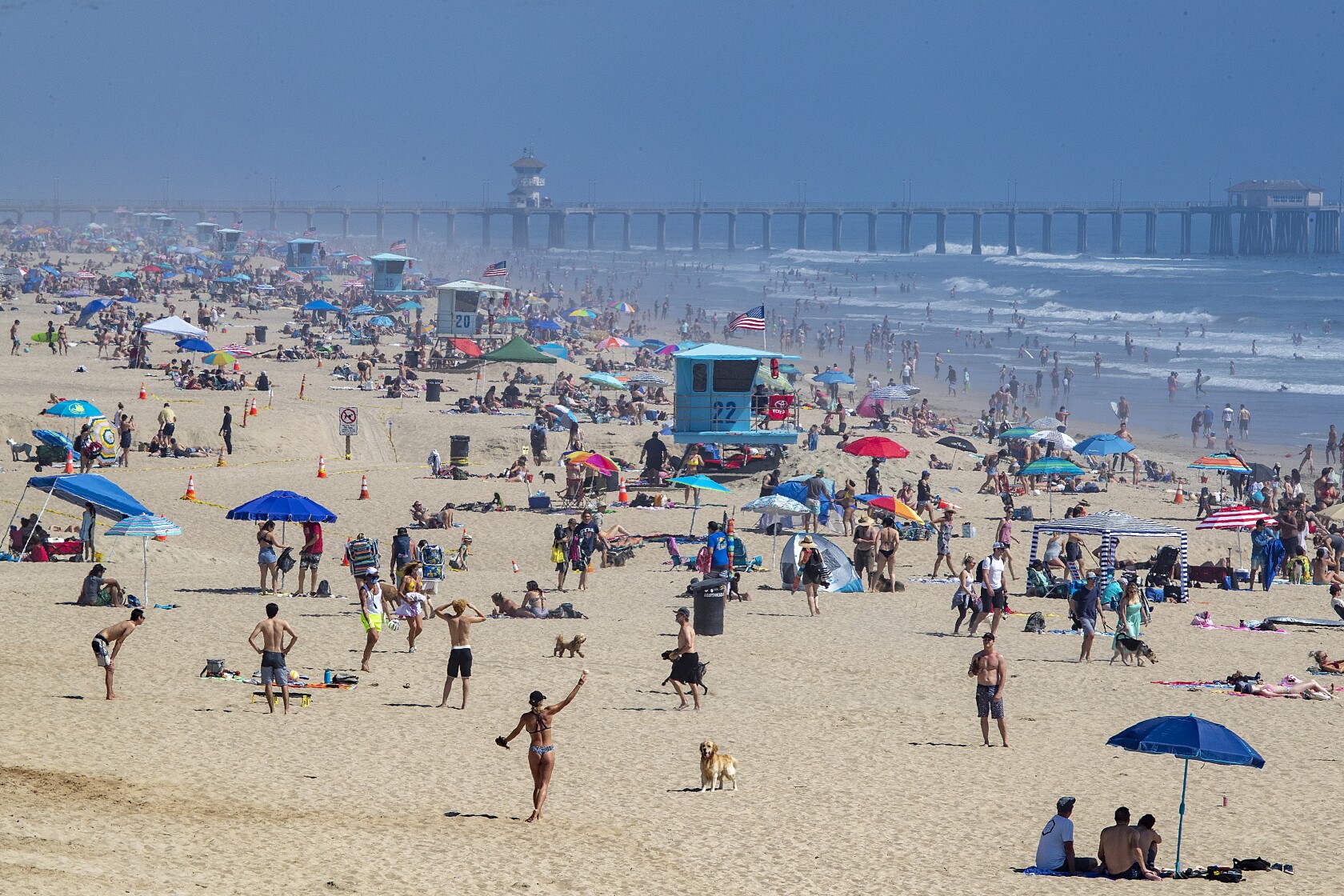
  • Look to hear from California’s Governor Newsom sometime in the next 48 hours regarding details about relaxation of the stay-at-home/social distancing orders. California’s actions have made a difference. As we’ve known for a century at least, social distancing works and it worked here. While the initial orders were emergent and broad-sweeping, look for the relaxation orders to be more surgical and to come with a period of evaluation. We needed quick, blanket action to prevent massive spread of the virus through the entire population of California when it was doubling every two days. With a doubling time of two days, the virus would have hit everyone in America within about 40 days. Now that we’re much more under control we can relax elements of social distancing one at a time with a period of observation to look for spikes. We can then see which of these measures were the most important in preventing spread of this virus. This process will give us valuable data and will help us in the fall when it’s likely the virus will surge again. Our break from the lockdown may not be as soon as we’d hoped though. This past weekend, some Californians jumped the gun and flocked to the beaches in numbers that are simply unwise at this point. This was a mistake and may very well lead to an uptick in the virus within the next two weeks. It’s just simple virology. If that happens we may not get our relaxation phase as soon as we would have, had people maintained social distancing per state and local public health department orders. Here’s hoping we don’t see that or that what we see isn’t enough to derail our break from the lockdown.
Allen J. Schaben/Los Angeles Times