Early on in the COVID-19 crisis, the US government, CDC and Public Health made an important error. US citizens were told that they should not wear masks. This mistake wasn’t completely without support in the scientific literature. Studies looking at mask-wearing as a way to prevent getting infected with a virus weren’t very convincing. Additionally, there’s evidence that people who wear masks may touch their faces more, a definite risk factor for becoming infected. Mainly though, in the early days we wanted to make sure that masks got to those who need them most–first responders and healthcare workers on the front lines.
It wasn’t very long after, however, before evidence started to mount that the US was looking at masks in the wrong way. Rather than focusing on the mask as protection for the wearer, studies were indicating that wearing a mask protects your neighbors from infection if you’re asymptomatic or presymptomatic. The virus is largely spread through respiratory droplets from coughing, sneezing, talking, singing or yelling. Wearing a mask, even one made from cloth, can be surprisingly efficient at trapping your infected droplets thereby preventing spread to others.
A widely sited recent study by De Kai, Guy-Philippe Goldstein, Alexey Morgunov, Vishal Nangalia, and Anna Rotkirch utilized a dynamic network-based compartmental model and individual agent-based modeling to study how masks can slow the spread of SARS-CoV-2. Compartmental models are a type of computational model that imitates how humans in different groups or “compartments” interact and similarly, agent based modeling follows the course of a disease through an individual or “agent” and tracks that agent’s interactions throughout the group or community. They’re fancy, they’re really cool and I have to admit they’re largely beyond me. This group of computational researchers, however, showed with these models that the spread of SARS-CoV-2 is significantly reduced when 80% of the population is compliant with mask-wearing in public by about day 50 of the pandemic. Their models also found that the response was nominal and basically unhelpful when only 50% of the public complies or if populations don’t start wearing masks in time. Similar to herd immunity from vaccination, in order to reap the benefits of masking and stop the spread of SARS-CoV-2, a significant majority of the population has to commit to complying in order to protect the larger community. When compliance slips we see viral outbreaks. If you’d like to better understand their methods, take a look at the author’s fascinating and compelling explanatory video.
To further examine the results of their modeling, the researchers compared them to real-world examples. They contrasted the response to the virus in countries and regions that adopted the practice of mask-wearing early and comprehensively with countries that don’t encourage or mandate universal mask-wearing. The correlations they found supporting their computational modeling were considerable. Countries and regions like Macau, Beijing, Shanghai, Hong Kong and Taiwan who made universal masking mandatory early saw a dramatic reduction of the disease from their peak and they generally avoided large-scale, strict lockdowns. On the other hand, countries with late or poor mask compliance demonstrated meager reduction of disease from peak even with the enactment of strict lockdowns.
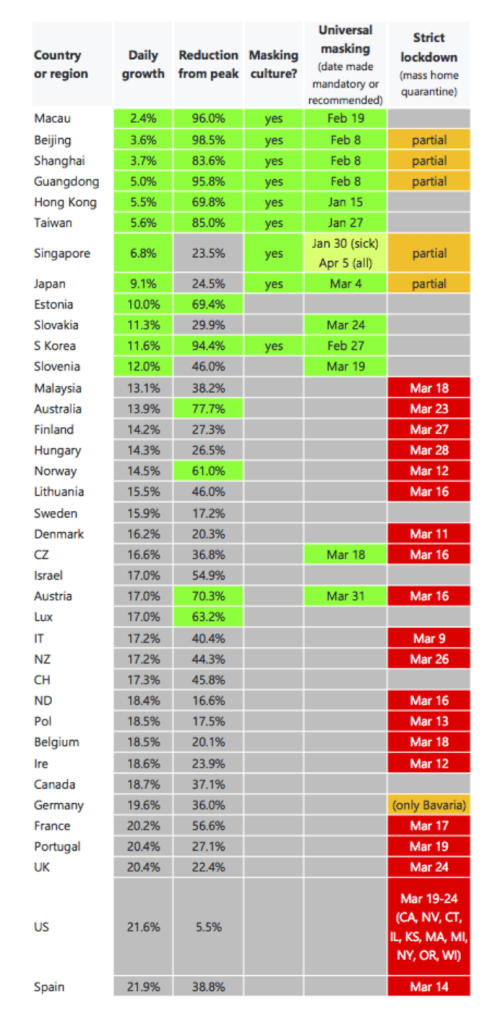
SEIR and Agent Based Models, Empirical Validation, Policy Recommendations/Used with permission
Similarly, the researchers looked at daily growth curves to show that countries with universal masking culture or early and comprehensive adoption of masking had significantly flatter disease curves than countries that don’t wear masks to any large degree.

SEIR and Agent Based Models, Empirical Validation, Policy Recommendations/Used with permission
Finally, the researchers placed countries into a quadrant map showing percent reduction from peak on the x-axis and daily growth on the y-axis. Countries in the bottom right of the graph had the largest percent reduction from peak disease and the lowest daily growth–less spread, quick recovery. Countries in the top left quadrant have had the smallest reduction in disease from peak and the highest daily growth–more spread, slow recovery. The United States sits squarely in this quadrant but countries with universal mask wear sit alone in the best quadrant of the graph.

SEIR and Agent Based Models, Empirical Validation, Policy Recommendations/Used with permission
The evidence for universal mask-wear is now decidedly compelling. We should all be wearing masks and we should start yesterday. So convincing is the science that on May 14, over 100 health experts wrote a letter imploring governments to mandate the wearing of cloth masks to stop the spread of SARS-CoV-2. While some states have taken this to heart, only 15 have actually passed laws mandating the wearing of masks in public. Most of those states are on the Eastern Seaboard. The science here is quite clear; wearing masks will significantly reduce viral spread. If enough people embrace the practice and we don’t wait until it’s too late, we can even stop the virus in its tracks. I think the greatest argument in favor or mask-wearing for those who oppose it on political or personal freedom grounds are the potential benefits for business. If we work to effectively quarantine our noses and mouths, we may not have to quarantine our bodies when this virus begins to surge again. And it will surge again. It’s what viruses do.
My family and I will be wearing our masks to protect you and your family. I’d be really grateful if you returned the favor.
I’d like to thank De Kai from the Hong Kong University of Science and Technology and the International Computer Science Institute at UC Berkley who graciously allowed me to use the three figures and graphs from his excellent article cited above. Please see these additional links provided by the author for more information on his study and the importance of universal masking.
 CHRIS DAEL