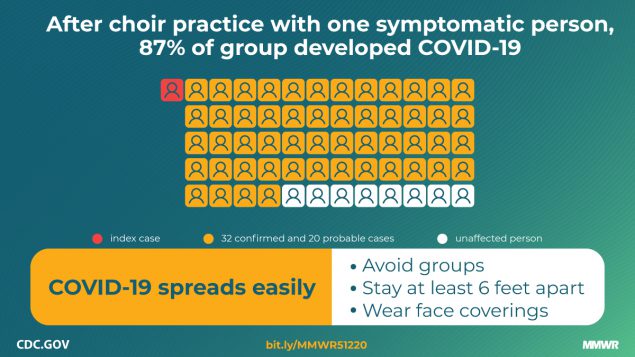
The Morbidity and Mortality Weekly Report (MMWR) by Lea Hamner et al. released today describes the impressive spread of SARS-CoV-2 from one symptomatic individual to 53 (33 confirmed and 20 probable) out of 61 members of a choir in Washington State. Of those infected, two eventually died.
The report startlingly illustrates some important phenomena related to rapid viral spread. First it’s important to understand that there are likely individuals who inherently spread more virus than the average person or there are at least circumstances that facilitate greater spread. A study by Asadi S. et al. in 2019 showed that the louder the voice, the greater the aerosol emissions. This is likely also true whenever forceful exhalation occurs. With activities like singing or vigorous exercise there comes the possibility that some individuals may be considered super-emitters who spread a much greater amount of virus-containing aerosols than typical individuals in normal situations. In this case the symptomatic choir member’s singing may have made them a super-emitter. On top of that, prolonged exposure in an enclosed space with little to no social distancing was an additional setup for aggressive viral spread through a large group; this is know as a superspreading event (SSE). SSEs are important public health concerns and have been documented in many pandemics. In a COVID-19 SSE, an infected individual can spread the virus to far more than the usual 2-3 people a typical person with SARS-CoV-2 does. In the Washington SSE for instance, the symptomatic choir member likely passed the virus on to dozens of people. SSEs are more likely to occur during gatherings at churches, concerts, sporting events, birthdays, funerals and at gyms or fitness centers. In each case we see the potential for a dangerous combination of people with loud voices or heavy breathing (super-emitters) coming together with large groups of people in enclosed spaces with less than optimal social distancing to create SSEs.
This report highlights the logistical challenges with large-scale reopening of society and businesses in the era of COVID-19, particularly for the highest risk sites. When venues such as those listed above do open, great care must be taken by both organizers of the venue and by visitors to the venue to reduce the risk of SSEs. Even with substantial attention and effort, it remains to be seen whether high-risk venues will be able to convince skittish visitors or members that it is safe to return as long as the virus is present in the community or until an effective vaccine is available.
 CHRIS DAEL